Software Development
Custom software, built by the engineers you actually talk to
Most businesses don't need bespoke software for its own sake. A lot of the time the software they need can be purchased off the shelf, from an SaaS company or something similar. Often, most businesses need the three days a week their team loses to a spreadsheet back. We build the systems that take that work off people's plates, and the senior engineers who scope it are the ones writing the code!
Off-the-shelf software is usually much cheaper, and when it fits what your business uses, we'll always recommend trying it before we quote you. Custom software earns its place when your process is genuinely unique to your business. When the tool you'd have to buy would need bending and transforming so far out of shape that you'd end up with a spreadsheet bolted to the side of it anyway.
When that's the case, what you get from us is a system designed around how your business actually runs. We've spent over a decade doing this across healthcare, fintech, logistics, and consumer, on systems handling millions of payments a year and on internal tools used by five to ten people. The care is the same either way.
The part that matters more than the build is what happens afterwards. Software that nobody owns rots away. Every business we've built for, we still work with today. Businesses love the personable approach and service they receive, and because the people who designed and development the initial software are still the ones who pick up the phone when something needs to change.
What we cover
Custom business systems
The system your business runs on, built around your process rather than a template. Portals, dashboards, job management, scheduling or reporting; whatever the shape of the work actually is. Usually this replaces a pile of spreadsheets or a heavily manual process and a lot of copying between them, or it could be a whole new SaaS you're wanting to develop!
Internal tools & automation
The unglamorous software that usually tends to save (or make) the most money. Tools that take the repetitive, manual, error-prone work your team does by hand and make it happen automatically, so your teams spend their day on the parts that need a human.
Integrations & APIs
Connecting the systems you already pay for so they stop being islands. CRMs, accounting, ERPs, fulfilment or third-party APIs. Most businesses have the data they need already; it's just sitting in multiple places or systems that don't talk to each other.
Legacy modernisation
Old software that still works but is holding you back, often desktop-only, out of support, or built by someone who left years ago. Sometimes that's a careful migration and sometimes it's an honest rebuild. We'll tell you which one you're actually looking at.
SaaS & product builds
If the software is the product, it needs to hold up under real customers from day one. Billing, permissions, and the boring reliability work that decides whether people trust you enough to keep paying. We'll handle it.
Taking over existing code
Projects that stalled, or projects that a previous developer walked away from are one of the worst situations to be in for a business. All of your investment is worthless and you aren't getting a return. We'll read the code and analyse what's there, and tell you honestly whether it's worth continuing or starting again, and pick it up from wherever you are. You often don't need to start from scratch to work with us.
How it works
Scope
We sit down with you and work out where the time and money actually goes, before anything gets built. You get a straight answer on what it'll cost, how long it'll take, and where the risks are, while you can still walk away.
Build in phases
Work ships in phases with milestones agreed upfront, so you're getting value partway through instead of staring at a black box for six months hoping it lands. Protal worked exactly this way, and the team were saving hours before the project finished.
Stay on
Once it's live, we don't hand you a login and vanish. Changes, fixes, and the next thing you think of six months later; we're still the people who know why the code is the way it is.
What's included
- Senior engineers writing the code - no account managers
- Scoping with real costs, timeline and risks before you commit
- Phased delivery with milestones you sign off
- Full source code and IP - you own it outright
- Documentation so any your team know how to use it
- Ongoing support and changes after launch
Ways to work with us
No fixed packages, because every business is different - these are the shapes an engagement usually takes. We'll scope the detail, timeline, and cost with you before anything starts.
Fixed-scope build
A defined project, start to finish.
- Scoped with costs and timeline upfront
- Phased milestones you sign off
- You own all the code and IP
Ongoing partner
We stay on long after launch.
- Changes, fixes and new features
- We keep the system healthy
- The same engineers who built it
Take over existing
Pick up a stalled or inherited build.
- An honest read on what you've got
- Continue or rebuild - we'll say which
- No starting from scratch
Proof
Cartwright Hands were running an entire lettings operation by hand; landlords, tenancies, compliance certificates, and document signing, all manual and all costing them time every single day. No product on the market did what they needed. We developed Protal, a bespoke software that now handles the whole lifecycle in one place.
Read the Protal case study →Our work
See all work →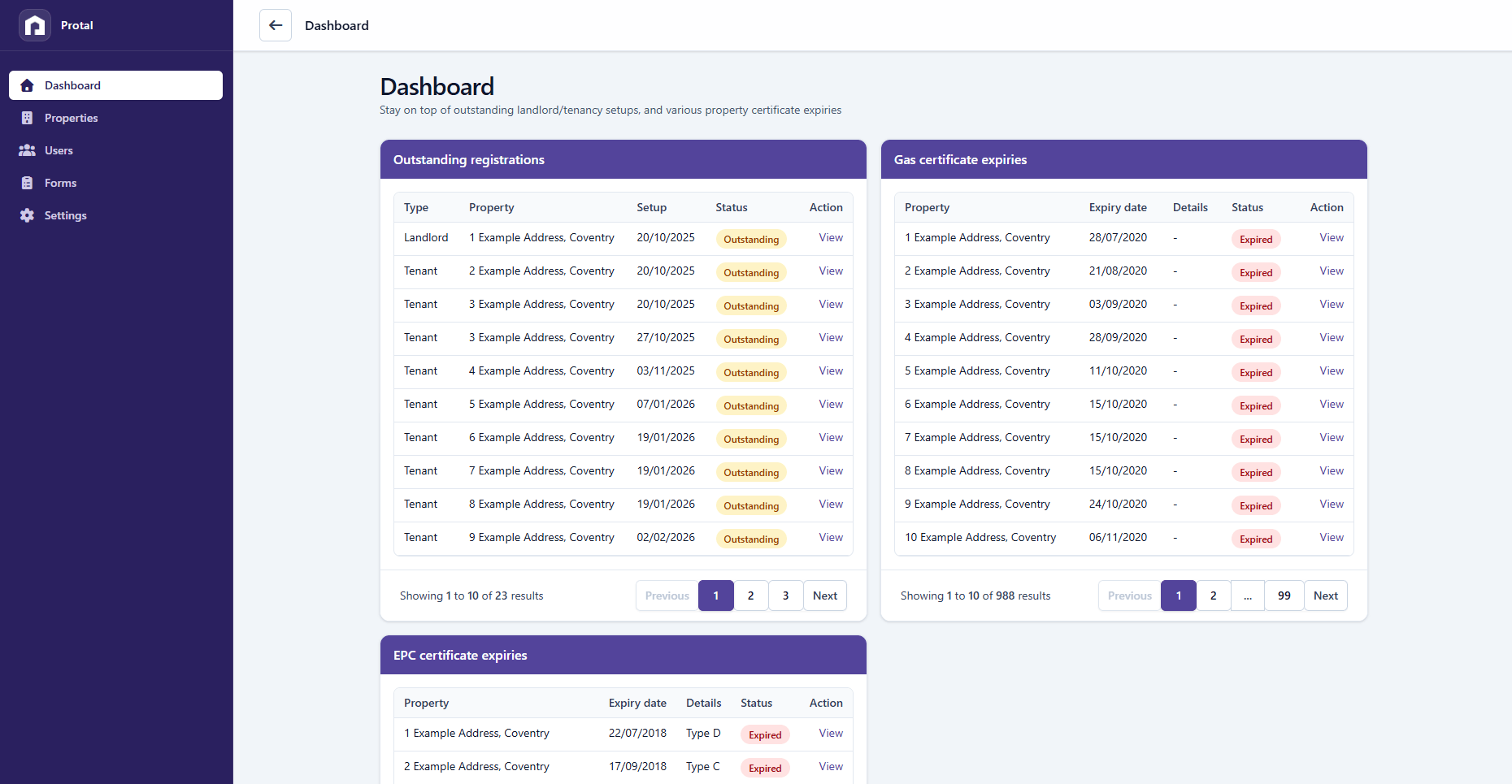
Frequently asked questions
How do I know whether I need bespoke software or something off the shelf?+
Ask what you'd have to change about how you work to make the off-the-shelf option fit. If the answer is 'not much' or 'nothing', you're not going to need bespoke software, and we'll tell you that. Bespoke software starts making sense when the workarounds become more than the job itself; when your team is exporting to a spreadsheet to do the bit the software can't, or when three tools each hold a little part of the job.
Do I own the code you write?+
Yes, completely. The source code and the intellectual property are yours, there are no licence fees to us, and you're not locked into working with us to keep using it. If you ever want to take it to another developer, you're able to with no issues from ourselves. We'd rather you stay because you want to, then because you have to!
Do you offer software hosting?+
Software hosting is usually something we offer for software we've developed for our clients. However, if you have software you already own that you'd like us to host, we discuss this with you and come to an agreement for us to host it. All management and maintenance is included with our software hosting packages, so you'll be able to deal with the parts of your business that really matter.
What are the costs of you hosting our software?+
The costs vary based on the software that you have. Unfortunately it's not a one size fits all. If it's software that has thousands of users each day, the costs are going to be significantly different compared to a small piece of software that 2 or 3 staff members use daily. Get in touch with us and we'll be able to provide you with an accurate quote for hosting our software. All of our software hosting packages include management and maintenance, so you can rest assured you'll be in safe hands.
How long does a project take?+
A focused tool that solves one specific problem can often be a matter of weeks. A full business system that several people depend on is more often a few months. The honest answer is that every project spec is completely different. We'll give you a real timeline with milestones during scoping rather than a hopeful number now.
What does custom software cost?+
It depends on scope, and we won't pretend otherwise; anyone quoting you a figure before understanding your process is guessing. What drives the cost is how many parts of your business it touches, how many systems it has to integrate with, and how much data needs migrating. You'll get a clear number with the risks laid out before you commit to anything, and if the number doesn't make sense against what you'd save, we'll tell you that too.
Can you integrate with the systems we already use?+
Usually, yes, and more often than not it's the highest-value part of the software we develop for existing clients. If a system has an API, we can connect to it. If it doesn't, there are usually still options, though we'll be upfront about which ones are realistically possible. Most of the businesses we work with already own everything they need; the problem is that none of it talks to anything else.
We have a half-finished project from another developer. Can you take it on?+
Yes, and it's something we've done on multiple occasions. We'll read through what exists first and give you a straight assessment. Whether it's a solid foundation worth continuing, or whether carrying on would cost you more than restarting. That assessment is the same either way, regardless of which answer earns us more work.
Can you modernise software we already rely on?+
Yes. Old software that still works is a genuine asset and we never rip things out for the sake of it. Sometimes the answer is incremental; update what's fragile, leave what's stable and solid. Sometimes the system is old enough that a gradual migration costs more than a rebuild, which is what happened with GOLD, a fifteen-year-old desktop application we rebuilt as a mobile-first web app.
Am I actually talking to the people building it?+
Yes. Abyss is a senior team. We don't have account managers, there's no sales handoff, and we're 100% UK-based, we never outsourced development that you find out about later. The engineers who scope your project are the ones who build it. We deliberately keep our existing project list short, so yours gets the attention it deserves, and if we're full we'll tell you straight rather than stretch ourselves and let your timeline slip.
What happens after it launches?+
Most clients want us to stay on, and that's the arrangement we prefer too. Ongoing changes, new features as your business shifts, and someone to call when something breaks. If you don't need that, it's not a problem. You own the code and you're free to go your own way. We'll still be at the end of the phone if you need any advice or help in the future.